

Powerful Lessons from the Death of Lazarus: John 11:1–16 Bible Study
Why Would Jesus Delay Helping Someone He Loved?
Few moments in the Gospel of John raise more questions than the death of Lazarus.
When Mary and Martha sent word that their brother was dying, Jesus didn’t rush to Bethany. Instead, He deliberately waited two more days.
Why would Jesus delay helping someone He loved?
As we study John 11:1–16, we’ll discover that God’s delays are never without purpose. What seemed like silence was actually preparing for one of the greatest miracles in Scripture—and an unforgettable revelation of Christ’s glory.
Setting the Scene for One of the Greatest Miracles (John 11: 1-4)
Bible Study Guide
(Verses 1-4) If you left the old east gate of the city of Jerusalem and headed in an easterly direction, you’d go down and up through the Kidron Valley. Once you were about one mile from the city, you would find yourself on the Mt. of Olives.
Continuing east almost another mile would bring you to the village of Bethany, where the sisters, Mary and Martha lived. Their brother Lazarus lived in this same village. It’s here where the news came from about the condition of Jesus’ good friend Lazarus.
Jesus and His disciples will use Bethany as a place to retreat back to daily after spending each day in Jerusalem during the last week of His public ministry.
John records Jesus’ first words about Lazarus to be very revealing about the coming circumstances. Jesus makes no bones about the fact that this is a divinely appointed event. Jesus was about to perform a miracle. You could say it was the miracle of all His miracles.
Lazarus didn’t happen to get sick and suddenly die for no reason. It was all a part of God’s plan. John made sure he recorded every intimate detail so the reader would understand what was occurring around this divinely appointed event.
Why Is the Death of Lazarus So Important?
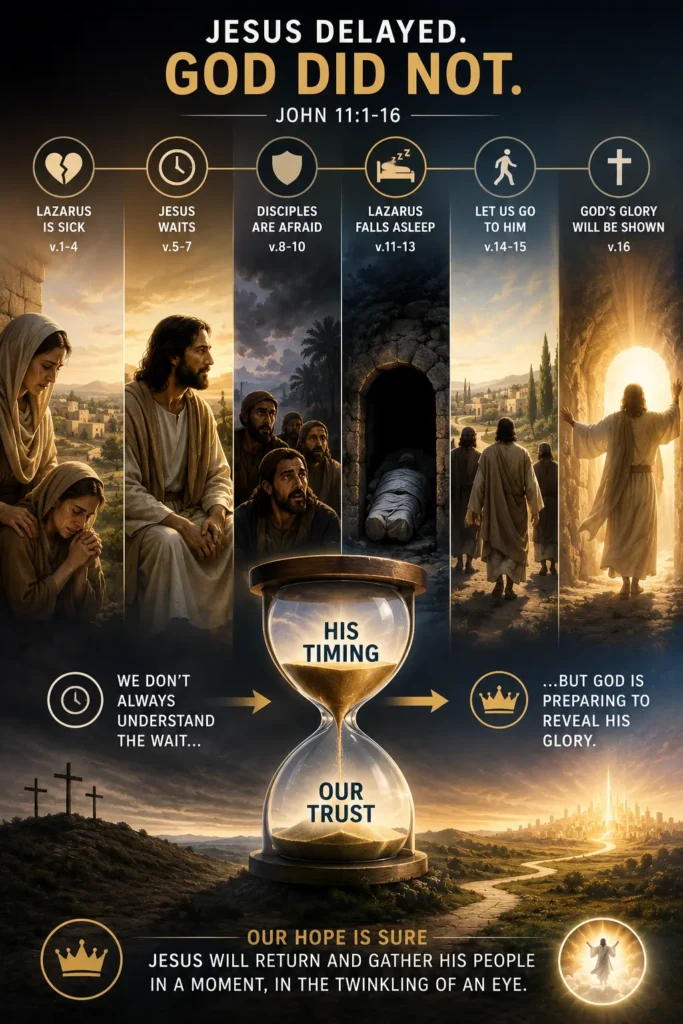
The raising of Lazarus is the seventh and final sign recorded in John’s Gospel before Jesus’ crucifixion.
Unlike earlier miracles, Jesus didn’t heal Lazarus while he was sick. He allowed Lazarus to die so that God’s power would be displayed in an unmistakable way.
This miracle became the turning point that intensified the religious leaders’ determination to put Jesus to death.
John uses almost the entire chapter solely dedicated to the details of this event. We’ll see in a moment why each fact that John writes about was included in this story. There is more written by John about this one miracle than any other miracle recorded in his gospel.
This moment begins a powerful sequence of events that unfolds throughout the final chapters of John. To see how this miracle fits into the larger story, explore our complete Book of John Bible study covering chapters 11–21.
Why Did Jesus Wait Two Days? (John 11:5-7)
(Verses 5-7) The words in these verses seem puzzling to us as readers. Imagine for a moment how the disciples felt when Jesus didn’t drop everything He was doing to go and help His friend Lazarus.
Jesus didn’t react for two whole days after hearing Lazarus’s health condition. His disciples were likely very perplexed by this knowing how much Jesus loved Lazarus.
God’s delays are not God’s absence.
From a human perspective, Jesus arrived too late. From God’s perspective, He arrived at exactly the right moment.
Sometimes God answers our prayers immediately. Other times He allows us to wait because He is accomplishing something greater than we can yet see.
John 11 reminds us that God’s timing is always perfect, even when it doesn’t match our expectations.
We must always trust in His timing and with patience we eventually see why his timing is perfect and sufficient for us.
Reflect:
When God doesn’t answer immediately, how do you respond?
- Do I trust God’s timing even when I don’t understand His delays?
- Have I mistaken God’s silence for God’s absence?
Apply:
- Think about one prayer you’ve been waiting on God to answer.
- Instead of asking only “Why?”, ask, “Lord, what are You teaching me while I wait?”
Why Were the Disciples Afraid to Return? (John 11:8-13)
(Verses 8-9) They were not heading back to Jerusalem where the Jews attempted twice to stone Jesus. But the fear was that Bethany was only two miles east of Jerusalem. Any word that Jesus might be in the area could stir up a mob to go looking for Him.
Jesus asks His disciples to trust in His timing. He also wants them to trust in Him as the light that will guide them while He’s still there with them. If Jesus is there to do the work of His Father, then the disciples must trust that these events are fully controlled by God.
At this point, the disciples of Jesus were still learning a great deal about Him. In a few moments, they’re going to learn much more.
(Verses 11-13) Two days have now past since the news of Lazarus’s illness. God’s timing allowed for this to take place. It was not Jesus’ purpose to heal a sick man, but rather to raise a dead man.
Why Did Jesus Say Lazarus Was Sleeping? (John 11:14-16)
When Jesus said Lazarus had “fallen asleep,” He wasn’t denying the reality of death. He was showing that, for those who belong to Him, death is not the end.
Just as sleep is temporary before awakening, the believer’s death is temporary before the resurrection.
The term “fallen asleep.” is a New Testament euphemism that means death. The death of Lazarus was a temporary thing. The idea of “falling asleep” anticipates the coming resurrection.
The disciples assume that Lazarus truly fell asleep, but Jesus meant that He died.
(Verses 14-15) After Jesus told His disciples plainly that Lazarus was dead. Jesus said something else that likely left the disciples puzzled as to what Jesus meant.
“and for your sake I am glad I was not there, so that you may believe. But let us go to him.” (John 11:15)
Jesus being glad that He wasn’t there earlier for Lazarus His friend made no sense to the disciples. But they were soon to understand why Jesus waited for Lazarus to pass.
What Can We Learn From Thomas’s Response?
(Verse 16) It’s possible that in this last verse John gives us a glimpse into the doubts that Thomas had about Jesus. This doubt would come to full bloom after Jesus’ death. But the power of God that Thomas doubted on this day would bring Him to believe upon seeing the nail marks in Jesus’ hands and feet and the mark on His side.
Notice, Thomas doesn’t lack devotion to Christ. He surrenders to following Jesus. He just has difficulty understanding what God’s plan is for all of them.
Thomas will finally learn that God’s plan is for him to fully surrender to Christ and His plan. Thomas just takes a different path than others who come to believe.
Then Jesus told him, “Because you have seen me, you have believed; blessed are those who have not seen and yet have believed.” (John 20:29)
Reflect:
Thomas chose to follow Jesus despite uncertainty.
- Am I willing to obey Christ even when I can’t see the outcome?
- Is fear keeping me from taking a step of faith?
Apply:
- Choose one area this week where you will trust God instead of fear.
- Take one step of obedience, knowing that Christ walks with you even when the future is uncertain.
Key Lessons from the Death of Lazarus
- God’s delays are never without purpose.
- Jesus’ timing is always perfect.
- Faith grows as we learn to trust Christ during seasons of waiting.
- Death is not the end for those who belong to Jesus.
- God often accomplishes His greatest work when situations seem hopeless.
Don’t Stop Here! Continue the Story
Jesus has revealed why He delayed—but Mary and Martha still don’t understand.
In the next study, we’ll witness one of the most moving conversations in the Gospels as Jesus declares one of His greatest “I AM” statements:
“I am the resurrection and the life.” (John 11:25)
Discover why this promise changes everything for those who believe in Him.
Closing Reflection on the Death of Lazarus
Friends, One of the hardest lessons I’ve had to learn is that God’s delays are not God’s denials.
After losing my parents as a child, there have been many times when I’ve prayed, waited, and wondered why the Lord didn’t seem to answer as quickly as I had hoped. Like Mary and Martha, I’ve wrestled with questions and struggled to understand His timing and purpose. Yet, looking back, I’ve discovered that God was faithfully working even when I couldn’t see His hand.
The death of Lazarus reminds me that what appears to be the end of the story is often the place where God is preparing to reveal His greatest glory. Jesus wasn’t late. He arrived exactly when the Father’s purpose would be displayed most clearly.
That same truth encourages me today. No matter how dark the circumstances may seem, our hope is never anchored in this world but in Christ. One day, the Lord will fulfill His promise to gather His people to Himself. In a moment, in the twinkling of an eye, those who have placed their faith in Jesus Christ will be caught up to be with Him forever.
Until that glorious day, may we trust His perfect timing, remain faithful in our waiting, and walk by faith rather than by sight—confident that the Savior who called Lazarus from the tomb will one day call His children home.
Closing Prayer
Heavenly Father,
Thank You for reminding us through the death of Lazarus that Your timing is always perfect, even when we cannot understand Your ways. Strengthen our faith when our prayers seem unanswered and help us trust that You are always working for Your glory and for our good.
Teach us to wait with confidence, to walk by faith instead of sight, and to rest in the assurance that nothing is beyond Your power. When fear, doubt, or disappointment fills our hearts, fix our eyes on Jesus—the One who has authority over life and death.
Thank You for the hope we have in Christ. We eagerly look forward to the day when He will fulfill His promise to gather His people to Himself, and every tear, every sorrow, and even death itself will be swallowed up in victory.
Until that glorious day, help us remain faithful, encourage others with the hope of the gospel, and live each day ready for our Savior’s return.
In the mighty name of Jesus we pray, Amen.