

John 9 Bible Study: Jesus Healing the Blind Man and What It Means Today
Why Would Jesus Allow Someone to Be Born Blind?
The healing of the blind man in John 9 is far more than an incredible miracle. It answers one of life’s hardest questions: Why does God allow suffering?
When Jesus healing the blind man astonished the crowds, He also challenged a common belief—that suffering is always the result of personal sin. Instead, Jesus revealed that God can use even our greatest hardships to display His glory.
As we study John 9, we’ll discover what this miracle teaches about suffering, faith, spiritual blindness, and trusting God’s purposes.
Why Was the Blind Man Born Blind? (John 9:1-5)
Bible Study Guide
(Verses 1-5) The disciples make the simple mistake of assuming this man was born blind because either his parents or he himself had sinned. We can often find ourselves thinking in this fashion. It’s happened to me on many occasions.
What did I do wrong? What did my parents do wrong?
When I was twelve years old, I lost both of my parents within just a few years. Like many people who experience tragedy, I searched for answers. I wondered if there was some hidden reason that only God knew behind my loss. John 9 reminds me that while we may not understand God’s purposes, we can trust that His ways are always perfect and His plans are greater than we can see.
While we know that God disciplines people for their actions, we don’t know all the reasons behind His actions. God doesn’t always provide us with the answers. The blind man healed by Jesus speaks to the mystery of God’s ways.
God reminds us of the truths through His servants Isaiah and Paul:
“For my thoughts are not your thoughts,
neither are your ways my ways,”
declares the Lord.
“As the heavens are higher than the earth,
so are my ways higher than your ways
and my thoughts than your thoughts.” (Isaiah 55:8-9)
“Who has known the mind of the Lord?
Or who has been his counselor?” (Romans 11:34)
It’s important that we always fully trust in the Lord our God. Understanding that all His ways are holy, righteous, perfect, and just. This is especially clear in the lesson of the healing of the blind man in John 9.
Fortunately for the disciples, Jesus provided a clear answer to the reasons why this man’s been blind since birth. In the miraculous healing of the blind man, Jesus shifts the disciples’ perspective.
If the curious question by the disciples of the man’s blindness were true, than we would all be blind. Because all people have sinned and fallen short of the glory of God. This would make us all blind from birth. In fact, we are spiritually blind from birth. The healing Jesus performs for the blind man is both a physical and spiritual lesson for us.
The man was born blind not due to his sin but for God’s glory.
Reflect and Apply:
- When suffering enters my life, do I immediately assume God is punishing me?
- Am I trusting God’s wisdom even when I don’t understand His purposes?
- Trust Him during unanswered questions instead of demanding immediate explanations.
- Obey His Word even when the path ahead isn’t clear.
Why Did Jesus Use Mud to Heal the Blind Man? (John 9:6-15)
(Verses 6-15) Why do you suppose Jesus went through the steps He did to set the blind man up to be healed? Then gave him instructions to wash his eyes in the Pool of Siloam. The process clearly details how the healing of the blind man unfolded step by step, inviting us into the moment.
After all, we witnessed Jesus with only a few words heal the royal officials son while not even being in his presence. Remember in chapter four, Jesus was in Cana and at the request of the royal official, Jesus healed his son who was lying sick in Capernaum.
It’s likely that Jesus was testing the man’s faith to see if he truly believed that Jesus could open his eyes to see. As Paul once stated himself that faith comes by hearing and hearing by the word of Christ. This strong faith led to the eventual healing of the previously blind man.
“Consequently, faith comes from hearing the message, and the message is heard through the word about Christ.” (Romans 10:17)
Jesus could have healed the man instantly with a single word.
Instead, He chose to make mud, place it on the man’s eyes, and send him to wash in the Pool of Siloam.
The power wasn’t in the mud or the water—it was in Jesus.
The blind man responded in obedient faith before seeing the miracle. His willingness to trust Christ became part of his testimony.
Throughout John’s Gospel, genuine faith often leads to greater revelation of who Jesus truly is.
Was Jesus concerned with his physical blindness or his spiritual blindness? Or was He concerned with both? In a moment, we’ll take a closer look at the healing of the blind man from both physical and spiritual perspectives.
Why Did Jesus Heal the Blind Man on the Sabbath? (John 9:16)
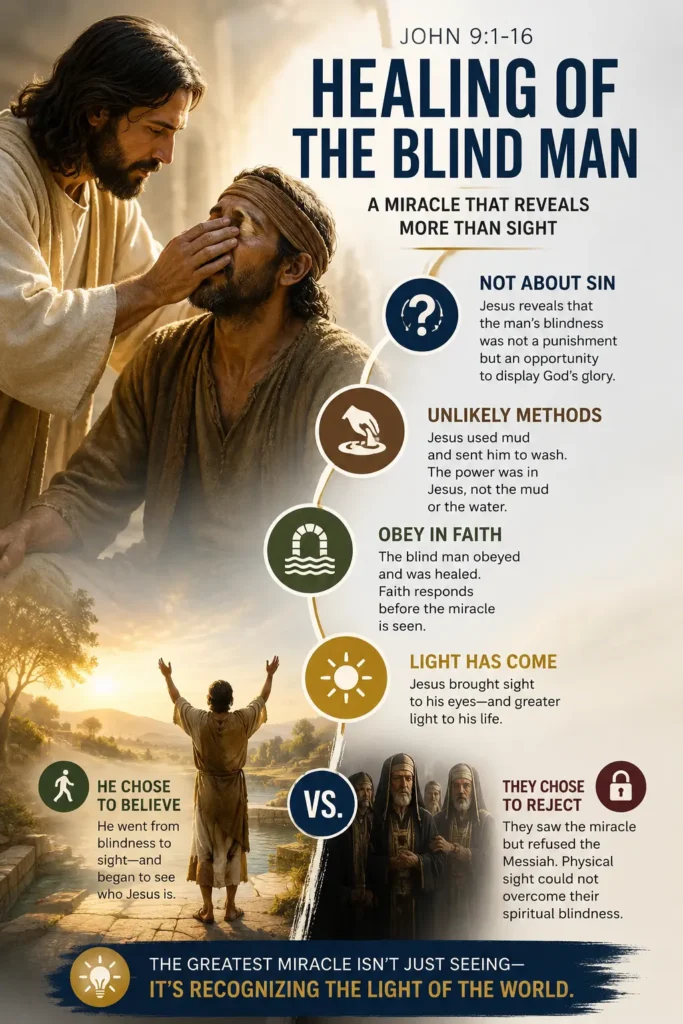
(Verse 16) The Pharisees were more concerned that Jesus healed on the Sabbath than that a man born blind could now see.
Their devotion to religious traditions prevented them from recognizing the One those traditions pointed toward.
This contrast reminds us that religious knowledge alone does not produce saving faith. Only a heart willing to receive Christ can truly see.
While Jesus performs incredible miracles before their eyes, the Pharisee’s continue maintaining their grip on the law. They focus on the laws of the Sabbath that no work shall be done on this day. This creates controversy between the Pharisee’s and Jesus.
The very law they struggle to fulfill which condemns them, they continue to cling to. Whereby the Savior stands before them extending His hand of forgiveness of their sins and they’re blind to it. Unfortunately, they missed the significance of the healing of the blind man, prioritizing tradition over revelation.
Unfortunately, this is the same blindness that continues in the eyes of God’s chosen people today.
The veil of blindness will be removed when the fullness of the Gentiles has come in. Then they will accept Jesus as their Messiah. This will occur at the end of the tribulation when all Israel (Remnant) will be saved. Just as in the story of the healing of the blind man, eventually spiritual eyes will be opened.
“I do not want you to be ignorant of this mystery, brothers and sisters, so that you may not be conceited: Israel has experienced a hardening in part until the full number of the Gentiles has come in, and in this way all Israel will be saved. As it is written:
“The deliverer will come from Zion;
he will turn godlessness away from Jacob.
And this is my covenant with them
when I take away their sins.” (Romans 11:25-27)
Reflect:
Take a moment to examine your own heart.
- Am I more concerned with following religious routines than growing in a relationship with Jesus?
- Do I celebrate God’s work in the lives of others, or am I quick to criticize how He chooses to work?
- Are there traditions or personal preferences that sometimes keep me from seeing what God is doing?
- When God answers prayer in unexpected ways, do I trust His wisdom or question His methods?
Apply:
This week, ask God to open your eyes to His work around you.
- Thank Him for His grace rather than relying on your own efforts.
- Look for opportunities to rejoice when God works in someone else’s life.
- Read God’s Word with a heart that seeks to know Christ, not simply to gain knowledge.
- Ask the Holy Spirit to reveal any attitudes that may be keeping you from seeing Jesus more clearly.
Beyond Physical Healing
The blind man healed by Jesus was much more than a compassionate miracle—it was a living illustration of a far greater reality.
Jesus restored the man’s physical sight, but John is preparing us to see something even more remarkable. As the story unfolds, it becomes clear that the greatest blindness isn’t found in the man who couldn’t see—it’s found in those who refuse to believe despite witnessing the miracle.
The once-blind man begins to recognize who Jesus truly is, while the religious leaders become increasingly hardened in their unbelief. The miracle exposes a sobering truth: it is possible to have perfect physical vision yet remain spiritually blind.
In the next section of John 9, we’ll explore physical blindness vs. spiritual blindness and discover how this miracle becomes a powerful lesson about faith, unbelief, and the kind of sight that only Christ can give.
The greatest danger isn’t physical blindness—it’s failing to recognize Jesus when He is standing right in front of us.
Key Lessons from the Healing of the Blind Man
- Not all suffering is caused by personal sin.
- God can use suffering to display His glory.
- Faith often requires obedience before understanding.
- Jesus brings both physical and spiritual sight.
- Religious tradition should never replace genuine faith in Christ.
Continue Your Journey Through John’s Gospel
The healing of the blind man is one of seven miraculous signs John recorded to prove that Jesus is the promised Messiah and the Son of God.
Continue your study through John’s Gospel and discover how every miracle points to Christ’s identity and God’s plan of salvation.
→ Continue the Gospel of John Bible Study Series
Closing Prayer
Heavenly Father,
Thank You for reminding us that Your purposes are always greater than our understanding. Help us to trust You when we face trials we cannot explain and to believe that You can use every circumstance for Your glory.
Open our eyes to see Jesus more clearly and give us hearts that respond to Him with humble faith and willing obedience. Guard us from spiritual pride, and help us rejoice in the work You are doing in our lives and in the lives of others.
May we walk each day in the light of Christ, bringing glory to You in all we do.
In Jesus’ name we pray, Amen.