

The 12 tribes of Israel in Revelation 7:5–8 stops everything.
The judgments pause.
The chaos holds its breath.
And heaven turns its attention to something incredibly specific:
A list of names.
At first glance, it feels small—almost easy to skip.
But don’t.
Because hidden in this list of the 12 tribes of Israel in Revelation is a message that should stop you in your tracks.
God is not reacting to history.
He is executing a plan—precise, intentional, unstoppable.
And before judgment continues, He marks 144,000 servants from Israel—not randomly, but by tribe.
But then something unexpected happens.
The list isn’t what you think.
One tribe is missing.
Another is added back.
The order is changed.
And the question presses in:
→ Why would God alter something this foundational… at this moment in history?
And even more personal:
→ What does this reveal about who God chooses, who He preserves, and what it means to be ready?
Let’s step into the text—slowly and simply—because this is not just about Israel.
It’s about how God works…
and whether we’re paying attention.
→ “To understand what changed… we need to go back to what God established first.”
Bible Study Guide
Table of Contents
- Something Hidden is Revealed About the 12 Tribes
- Why This List of Tribes? Why Now?
- Who Are the Original 12 Tribes of Israel?
- Who Are the Inheriting 12 Tribes of Israel?
- The Split Kingdom and Regathering of the 12 Tribes
- How are the 12 Tribes of Israel Transformed in Revelation 7?
- Comparing the Historical 12 Tribes of Israel
- Why Was the Tribe of Dan Removed From Revelation Tribes?
- What Is Revealed About the 12 Tribes of the Millennial Age?
Something Hidden in the 12 Tribes Is Revealed
(Verses 5-8) Since the Lamb began breaking the seals, judgment after judgment has thundered across the earth. But in Revelation 7, everything suddenly stops. Heaven calls for a pause—not because God’s wrath is finished, but because something extraordinary must take place first.
It’s as if the camera of John’s vision shifts, pulling us from the devastation on earth to a scene of divine strategy in heaven. Here, before the next wave of judgment falls, 144,000 Jewish servants of God are chosen and sealed. This seal is no mere mark—it is God’s supernatural protection, enabling them to boldly proclaim the gospel of Jesus Christ across a world in chaos.
Then comes a detail easy to miss, yet impossible to ignore. The list of tribes is different. These are not the exact same twelve tribes that emerged from Egypt under Moses. Something has changed. Over centuries of Israel’s history, the tribal lineup has been reshaped—by judgment, by blessing, and by the sovereign purposes of God.
Why this list of Tribes? Why now?
And what does it tell us about God’s plan for Israel—and for the world—in the last days?
Before we break it down, look closely—because this is what changed.
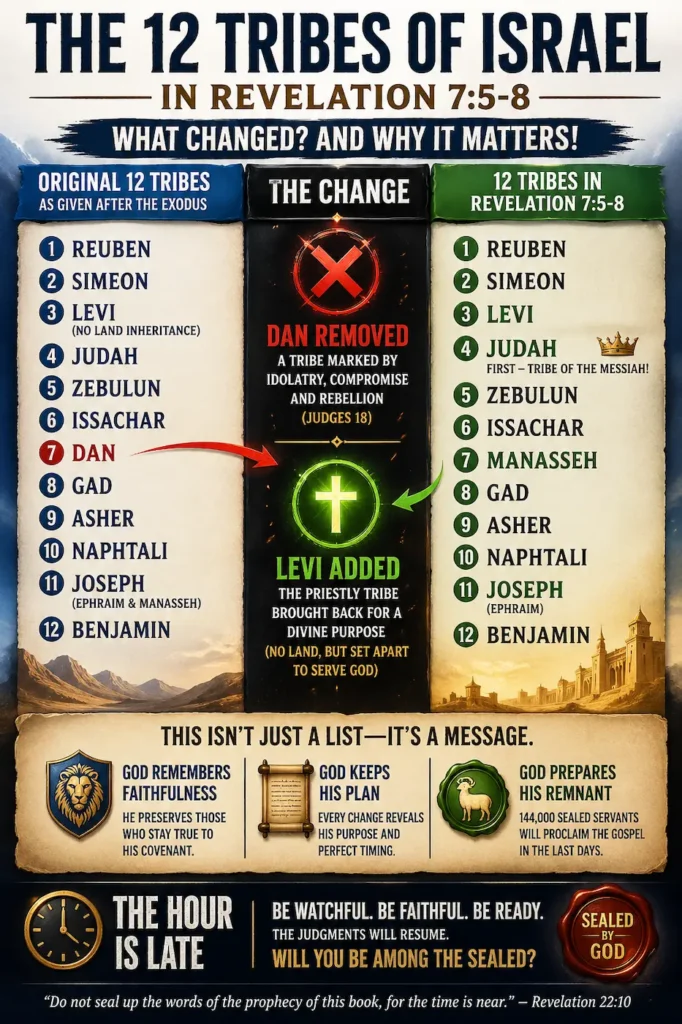
Don’t Miss This About the 12 Tribes of Israel in Revelation
- One tribe removed
- One tribe restored
- The order changed
→ That’s not random. That’s revelation.
The Original 12 Tribes of Israel
The original 12 tribes of Israel were all named after the 12 sons of Jacob, also called “Israel,” before God also called him “Israel.” The names of his 12 sons were…

These were the original 12 tribes of Israel. When the time came for Joshua to lead the Israelites into the promise land to inherit it, all the tribes received a portion of the land except for the Levi’s. They didn’t receive any land as an inheritance.
The Inheriting 12 Tribes of Israel
But even in the beginning, something unusual was already happening
Of the 12, one received a different inheritance. God made the Levi’s to be priests. They would be placed among various cities throughout Israel.

They would be representatives of the people to God and they would serve God directly. God would be their inheritance and their portion.
Jacob had inherited Joseph’s two sons, Ephraim and Manasseh. Because Joseph had brought blessings upon his family and saved them from the famine, he received a double portion for his inheritance. Ephraim and Manasseh both received an allotment of land.
Levi is out. Manasseh is added.
The Split Kingdom of Israel & Regathering of the 12 Tribes
After the time of King Solomon’s reign, Israel became a divided nation. The 10 northern tribes of Israel combined to become Northern Israel. This left the tribe of Judah in the south with the city of Jerusalem and the tribe of Benjamin.
Now—after centuries of rebellion, division, and exile—God brings us back to this list… but it’s no longer the same.
The Transformation of the 12 Tribes of Israel in Revelation
Don’t just scan this—notice what God is doing.
- Judah is no longer just a tribe—it’s first. Why?
- Levi returns—why bring priests into a moment of judgment?
- Dan disappears entirely—why erase a name?
→ This isn’t a genealogy.
→ This is a theological statement.
Now look closely:
| Original 12 Tribes (as given after the Exodus) | 12 Tribes in Revelation 7 | Notable Differences |
|---|---|---|
| Reuben | Reuben | Same position—firstborn of Jacob, though not the tribe of promise. |
| Simeon | Simeon | Same tribe in both lists. |
| Levi (excluded from land inheritance but counted as a tribe) | Levi | Included here—rare, since Levi usually wasn’t counted in land divisions. |
| Judah | Judah | Listed first in Revelation—tribe of Messiah, replacing Reuben’s birthright position. |
| Zebulun | Zebulun | Same in both lists. |
| Issachar | Issachar | Same in both lists. |
| Dan | Manasseh | Why was Dan omitted entirely in Revelation—possibly due to historic idolatry (Judges 18). |
| Gad | Gad | Same in both lists. |
| Asher | Asher | Same in both lists. |
| Naphtali | Naphtali | Same in both lists. |
| Joseph | Joseph (Ephraim) | Ephraim not named—represented under Joseph’s name. |
| Benjamin | Benjamin | Same in both lists. |
This isn’t just history.
This is a preview of how God acts at the edge of judgment.
Before wrath continues:
- He seals His people
- He defines His remnant
- He makes distinctions
And the question becomes unavoidable:
→ If God paused history today… would you be among those marked as His?
Comparing Original, Inheriting and Revelation Tribes
| 12 Original Tribes | 12 Inheriting Tribes of Israel | 12 Tribes of Israel in Revelation |
| Reuben | Reuben | Reuben |
| Simeon | Simeon | Simeon |
| Levi | Judah | Judah |
| Judah | Dan | Levi |
| Dan | Naphtali | Naphtali |
| Naphtali | Gad | Gad |
| Gad | Asher | Asher |
| Asher | Issachar | Issachar |
| Issachar | Zebulun | Zebulun |
| Zebulun | Ephraim | Joseph (Ephraim) |
| Joseph | Manasseh | Manasseh |
| Benjamin | Benjamin | Benjamin |
Why Was the Tribe of Dan Removed From the 12 Tribes of Israel in Revelation Tribes?
The absence of Dan should unsettle us.
This isn’t a minor omission.
This is a warning written into the structure of Scripture.
Dan’s history tells a story of:
- compromise
- idolatry
- dissatisfaction with God’s provision
By taking a closer look, we gain insight into why it may have been removed from the original list of tribes.
Judges 18 reveals that the Danites fell deeply into apostasy, turning away from God. Additionally, they were dissatisfied with the inheritance God had given them. These factors may help explain why the tribe of Dan was removed from the list.
Being along the Mediterranean, they often found themselves waring with Israel’s longtime nemesis, the Philistines.
The Danites eventually left their land to occupy a different land than the one God had given them. Thereby again, turning their backs on God (Judges 18).
They didn’t just drift.
They rejected what God assigned to them.
Let that sit for a moment.
→ God remembers faithfulness.
→ But He also records rebellion.
Not to confuse us—but to warn us.
And now, in Revelation 7, their name is gone.
This is all written in biblical history in order for us to understand the changes to the 12 tribes of Israel in Revelation.
This is a perfect example of how we ought to allow scripture to interpret scripture. We shouldn’t add, subtract or change what is not provided to us. But rather, trust in the Lord the information He gives us. All that we need to know, He provides for us.
God is good in all things, and in all things God is good!
The Hour Is Late
We are living in a prophetic convergence unlike any in history. The same headlines that fill our newsfeeds mirror the signs Jesus gave as the birth pains of His return—wars and rumors of wars, global instability, Israel surrounded by enemies, and a world primed for deception.
These are not distant possibilities; they are present realities. The pages of Revelation are beginning to cast their shadows on our day, and the events described are closer than we dare to think.
How will the 12 tribes of Israel play a role in the Millennial Kingdom?
The List Is Written—But Is Your Name?
Revelation 7 shows us something powerful:
God knows exactly who belongs to Him.
Not generally.
Not symbolically.
But specifically.
Name by name. Tribe by tribe.
And just as He seals the 144,000…
He is still calling people today.
→ Not into a tribe—but into salvation through Jesus Christ.
Because when judgment resumes… it won’t pause again.
Choose Your Response:
For the believer:
Stand firm. Stay watchful. Don’t drift into compromise like Dan. Live sealed, set apart, and ready.
For the undecided:
Don’t assume proximity to truth equals belonging to God. Come to Christ now—while the invitation still stands.
The Remnant, 12 Tribes and the Millennial Kingdom
The prophetic clock is racing toward midnight. Around us, the signs Jesus foretold—wars, unrest, moral decay, global upheaval, and Israel’s rising prominence—are converging like never before. Scripture warns that the Tribulation will soon unleash God’s wrath upon a rebellious world, yet even in judgment, His promises stand.
Zechariah 13:8–9 tells us that a third of Israel will survive, purified through fire, and will finally call upon the name of the Lord. That remnant will step into the Millennial Kingdom, not as a scattered people, but as the restored nation God always promised.
Twelve Tribes in the Kingdom Age
In that coming Kingdom, Jerusalem will be the throne city of Christ, and Israel will take her place as head of the nations (Isaiah 2:2–4; Micah 4:1–2). Ezekiel 48 describes a breathtaking picture: a renewed land with each tribe restored to its inheritance. Surrounding the city are twelve gates, each bearing the name of a tribe—three on each side—declaring for all eternity that God has kept His covenant word.
- 3 North Gates: Reuben, Judah and Levi
- 3 East Gates: Joseph, Benjamin and Dan
- 3 South Gates: Simeon, Issachar and Zebulun
- 3 West Gates: Gad, Asher, and Naphtali
Notice in the 12 Tribe Comparison Chart, the Millennial Kingdom tribes will be back to the original 12 tribes. God will restore His original intent for the first tribes of Israel to be those who God would bless the nations through.
Manasseh is removed. The tribe of Dan is restored.
The Gates of the Millennial Jerusalem and the 12 Tribes
These gates are not merely architectural features—they are declarations. Every entrance into that city will be a reminder that God preserves His people, keeps His promises, and fulfills His Word down to the last detail.
The remnant who survive the Tribulation will walk through them. They’ll be living testimonies of God’s mercy and power. And the convergence of signs we see today should stir our hearts with urgency—because the return of Christ is drawing near, and the day when those gates swing open may be far closer than we imagine.
The Interlude Continues
As this interlude in God’s judgment continues, John will share with us the second vision he sees before the pause from heaven comes to a conclusion. Then we’ll resume to the seventh and last seal judgment as the intensity of God’s wrath reaches a crescendo.
For a deeper dive into the last chapter of this age, continue in the Book of Revelation Chapters 1–11 Study Guides