

Death had already won.
Lazarus had been in the tomb four days. Hope was gone. The mourning had begun. Martha and Mary believed Jesus could have healed their brother — but now it was too late.
Then Jesus made one of the most powerful declarations in all of Scripture:
“I am the resurrection and the life.”
John 11 is not just about the death of Lazarus. It is about the moment Jesus revealed His authority over death itself.
When Hope Seemed Buried (John 11:17-20)
Bible Study Guide
(Verses 17-20) When Jesus and His disciples arrive in Bethany, John records that Lazarus’s body had been in the tomb for four days. This is a significant detail that John makes sure to include in the opening of this passage.
The disciples and other Jews of that day would have understood what it meant for Lazarus to have been dead for four days.
Up to this point in Jesus’ ministry, the disciples along with many people had witnessed Jesus perform some incredible miracles. Miracles that defy logic and could only be understood through the power of God.
Besides all the healing miracles, they also witnessed the raising of other people from the dead as recorded in (Mark 5:21-24, 35-43 & Luke 7:11-17).
But they had not yet witnessed the rising from the dead of a person that had been in the tomb for four days. What was the mystery behind the four days?
Reflect and Apply:
Lazarus had been dead four days. From a human perspective, the situation was beyond hope.
Yet Jesus arrived at the exact moment He intended.
- Have you ever felt like God was late in answering your prayers?
- What situation in your life feels impossible right now?
- Can you trust that God is still working even when you cannot yet see the outcome?
Sometimes God allows us to reach the end of ourselves so we can fully see His power.
Why the Four Days Mattered in the Death of Lazarus
Jewish tradition holds that after death, the soul hovers over the body for three days and departs from it on the fourth day.
Many of the Jewish traditions give no specific account for what exactly happens to the soul after death. Many varying traditions claim the soul hovers over the body for three to seven days, but the majority claim it to be three days.
The Jews who were in attendance at the tomb of Lazarus would have undoubtedly known that Lazarus had no chance of coming back to life. Especially in light of the fact that his soul had departed from his presence.
It’s important to understand that there is no biblical foundation in this belief of the soul lingering near the body of a corpse.
Reflect and Apply:
The people surrounding Lazarus believed death had permanently won.
But human understanding is limited while God’s power is unlimited.
- Are you relying more on human reasoning or God’s promises?
- Have you placed limits on what you believe God can do?
- What would it look like to trust God even when circumstances seem irreversible?
What seems impossible to us is never impossible for God.
Martha’s Grief Meets the Messiah (John 11:21-23)
(Verses 21-23) Jesus tells Martha that He is going to bring Lazarus back to life. She misinterprets what Jesus says by assuming He meant at the end of the age when the believers are gathered up with Christ in the rapture before the tribulation.
Martha’s heart was in the right place. Her mind was focused on the future she understood, not on the power that stood in front of her.
“I Am the Resurrection and the Life” — Jesus’ Greatest Promise (John 11:24-37)
(Verses 24-31) Martha believed in a future resurrection at the end of the age. But Jesus redirected her attention away from a distant event and toward Himself.
Jesus did not merely say He could resurrect the dead.
He declared:
“I am the resurrection and the life.” (John 11:25)
This is one of the seven great “I AM” statements in the Gospel of John — a direct declaration of His divine identity.
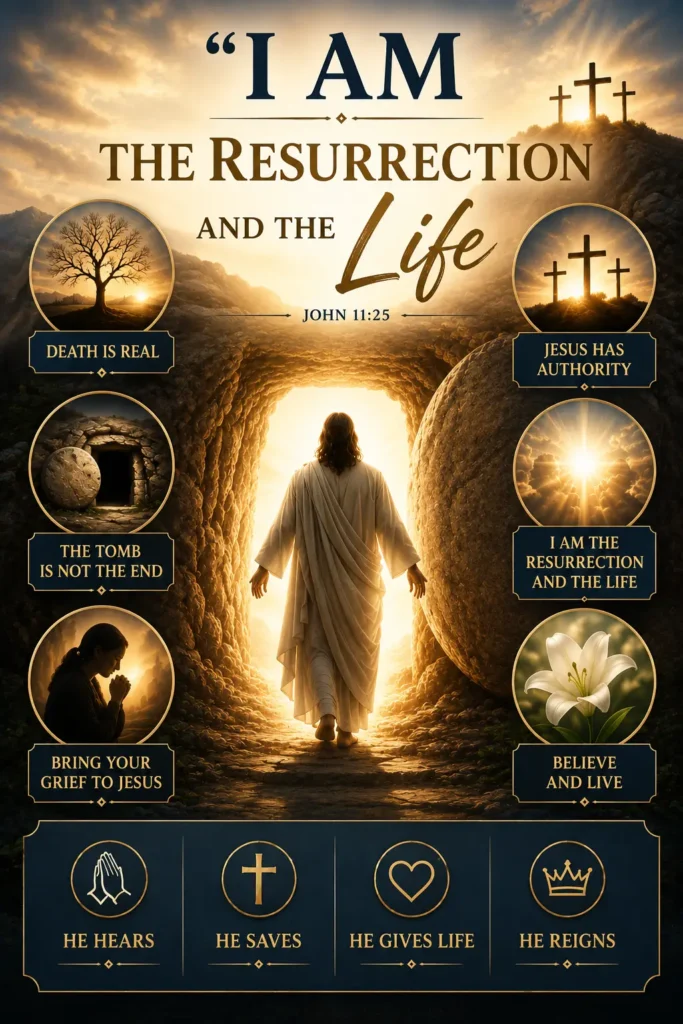
Jesus is not only the giver of life. He is life itself.
Standing before a grieving woman beside the death of Lazarus, Jesus revealed His authority over every grave, every funeral, and every fear of death.
The miracle Jesus was about to perform was not simply about bringing one man back from the tomb. It was a sign pointing forward to Christ’s own resurrection and the eternal life promised to all who believe in Him.
Death is humanity’s greatest enemy. It is the wages for sin. Yet Jesus stood before the tomb and declared that death does not have the final word.
That changes everything.
(Verses 32-37) Notice the similarities as well as the differences in how Martha and Mary approach Jesus. They both demonstrate their love for Him as believers. They both wish that He had arrived sooner in order that He might save their brother.
Mary, unlike her sister approaches Jesus in reverence and humbles herself before her Lord. Mary did the same thing when Jesus visited the two sisters in the story recorded by Luke (Luke 10:38-42).
We’re going to see Mary react the same way in the next chapter of John’s gospel when she pours expensive perfume on Christ’ feet and wipes them with her hair (John 2:1-8).
Mary’s relationship with Christ is quite different from her sister Martha’s.
Reflect and Apply:
Jesus did not simply promise resurrection someday.
He declared that resurrection and life are found in Him.
- Have you trusted Jesus personally for eternal life?
- Are you living with the hope that death is not the end for believers?
- How should Christ’s victory over death change the way you face fear and uncertainty today?
Because Jesus lives, believers never face death without hope.
Continue Your Study of Jesus in John’s Gospel:
The Moment Jesus Defeated the Death of Lazarus (John 11:38-40)
(Verses 38-40) Jesus understands our plight as we venture through this world. He Himself
experienced sorrow at the loss of His friend and felt the hurt of those around Him.
Jesus requests the stone be removed.
Did Jesus need them to move the stone to raise Lazarus? No! Jesus commanded the stone to be removed so that everyone present would witness the miracle openly and unmistakably.
For example, when Jesus healed the blind man at Bethsaida. Did Jesus have to spit on some dirt to wipe on the blind man’s eyes so He could heal his blindness? No!
He reminded them again that they would see such things as the miracle He’s about to perform if they believed.
The Prayer That Shook Death to Life (John 11:41-44)
(Verses 41-44) The stone had been rolled away. The tomb was open. The smell of death lingered in the air.
Everyone standing there knew Lazarus was dead. Four days had passed. Hope was gone. Human strength had reached its limit.
Then Jesus looked toward heaven and prayed. Jesus said:
“Father, I thank thee that thou hast heard me.” (John 11:41)
Before calling Lazarus out of the tomb, Jesus paused to publicly give glory to the Father. This prayer was not spoken because Jesus lacked power. He had complete authority over death itself. Instead, Jesus prayed so that those standing around Him would believe that He was sent by the Father.
At that moment, the crowd witnessed something astonishing.
A prayer preceded resurrection. A prayer stood at the doorway of impossible power.
Then Jesus cried out with authority:
“Lazarus, come out.” (John 11:43)
And death obeyed.
The man who had been wrapped in grave clothes walked out of the tomb alive.
The death of Lazarus was no more because the Author of life had spoken.
Jesus demonstrated that death is not stronger than God. The grave is not beyond His reach. What humanity sees as impossible is completely subject to the authority of Christ.
This miracle also points forward to Jesus’ own resurrection. The One who called Lazarus out of the tomb would soon walk out of His own tomb in victory over sin and death forever.
Reflect and Apply:
Before Lazarus walked out of the tomb, Jesus prayed publicly to glorify the Father.
Prayer still matters because God still hears.
- Is prayer your first response or your last resort?
- What burden do you need to place before God today?
- Have you stopped praying for something because it seems impossible?
No grave is too deep for the power of God.
The raising of Lazarus marks a turning point that accelerates the events leading to the cross. You can see how this moment fits within the full narrative in our Book of John Bible study on chapters 11–21.
Why Prayer Matters Today
The prayer of Jesus before Lazarus was raised reminds us that prayer is not empty religious routine.
Prayer connects us to the power and presence of God.
Far too often, believers treat prayer as a last resort instead of their first response. Yet throughout Scripture, prayer precedes some of the greatest displays of God’s power.
Prayer matters because it:
- strengthens our faith during impossible situations
- reminds us God is still in control
- aligns our hearts with His will
- brings peace in grief and uncertainty
- deepens our relationship with Christ
- invites us to depend on God instead of ourselves
Martha and Mary stood helpless before the tomb of their brother. But Jesus showed that no situation is hopeless when placed before the Father.
There are still “tombs” people face today:
- broken hearts
- fear
- addiction
- despair
- spiritual deadness
- grief
- impossible circumstances
Prayer does not mean we control God. It means we trust the One who has authority over life, death, and eternity.
The same Savior who stood outside Lazarus’s tomb still hears the prayers of His people today.
Reflect and Apply:
- Do you bring impossible situations to God in prayer first or only after everything else fails?
- What area of your life feels hopeless right now?
- Have you truly trusted Jesus as “the resurrection and the life”?
Sometimes God does His greatest work in the places we believe are already beyond hope.
Final Thoughts on the Death of Lazarus
The raising of Lazarus was more than a miracle.
It was a declaration.
Jesus proved that no grave is beyond His authority.
The same Savior who stood outside Lazarus’s tomb still offers eternal life today. Through His own death and resurrection, Jesus conquered the power of sin and death forever.
When Jesus said:
“I am the resurrection and the life,” (John 11:25)
He was making a promise to every believer.
Death does not win.
Christ does.
Reflect and Apply:
The raising of Lazarus points beyond one miracle to the eternal hope found in Christ.
Jesus conquered death so believers could have everlasting life.
- Are you living with confidence in Christ’s promises?
- Have you fully surrendered your life to Jesus?
- Who in your life needs to hear the hope of the gospel today?
The same Savior who called Lazarus from the tomb still calls people to life today.
Closing Prayer
Dear Lord Jesus,
Thank You for being the resurrection and the life. When fear, grief, and hopelessness overwhelm us, remind us that You have power even over death itself. Strengthen our faith to trust You fully and help us live with the hope of eternal life through Christ alone.
It is in Your blessed name we pray. Amen.