

Christ’s Warning to the Church of Sardis: Wake Up Before It’s Too Late (The Dead Church)
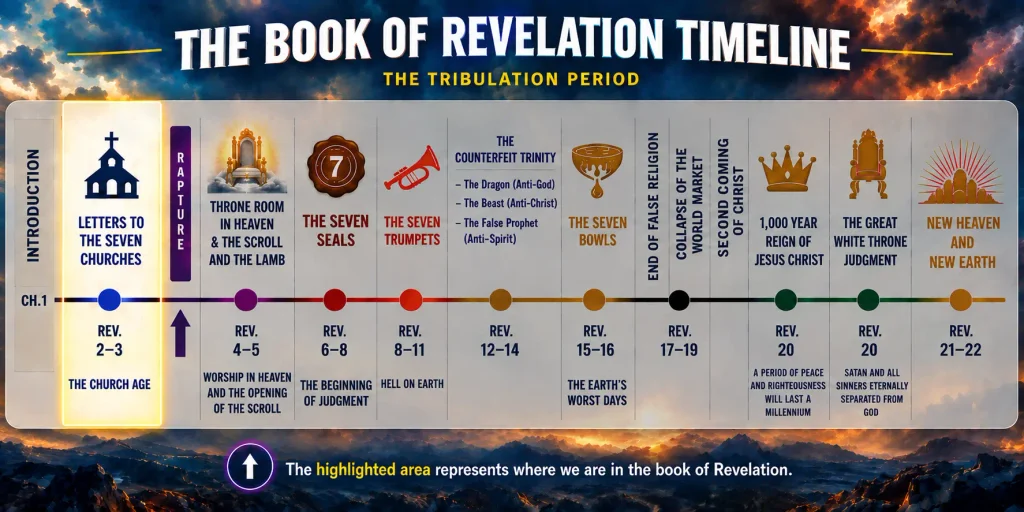
📍Where Are We in Revelation?
Behind us:
Jesus has begun His examination of the seven churches. Ephesus was warned about losing its first love, while Pergamum was commended for standing firm but warned about compromise. Christ is revealing that outward faithfulness must be matched by genuine spiritual devotion.
Where we are:
Jesus now addresses Sardis—a church with a reputation for being alive but one that He declares is spiritually dead. He calls them to wake up, strengthen what remains, remember what they received, and repent. Yet a faithful few have not compromised, and Jesus promises they will walk with Him in white.
Ahead:
Jesus will continue speaking to the churches in Philadelphia and Laodicea. These two represent our current churches. After these seven letters are complete, Revelation will move from the earthly Church to the heavenly throne room and the judgment events that unfold from there.
Key thought:
Jesus sees beyond reputation. A church may appear alive to the world while being spiritually dead before Christ. He calls His people to wake up, repent, and remain faithful.
The One Who Holds the Seven Spirits (Revelation 3:1)
Bible Study Guide
(Verse 1) When you think about the church of Sardis in Revelation 3, I want you to picture this: a church that looked alive on the surface—busy, respected, and even admired by those around them. But when Jesus looked closer, He saw only death. That’s sobering, isn’t it?

Sardis itself was a wealthy and influential city, the capital of ancient Lydia in Asia Minor. It thrived on trade, manufacturing, and philosophy. Pagan temples stood tall—including one dedicated to Artemis—and the city was even home to the famous Greek philosopher Thales. To the outside world, Sardis looked strong, cultured, and full of life.
And the church in Sardis reflected that same outward appearance. From the outside, it seemed active and vibrant. But Jesus, the One who sees past the surface and into the heart, had no praise for them. Not a single good word. Instead, He gave them a chilling diagnosis: “You have a reputation of being alive, but you are dead.”
This is the very same warning He gave to the Pharisees in Matthew 23—those who appeared righteous outwardly but were full of hypocrisy within.
“Woe to you, teachers of the law and Pharisees, you hypocrites! You are like whitewashed tombs, which look beautiful on the outside but on the inside are full of the bones of the dead and everything unclean. In the same way, on the outside you appear to people as righteous but on the inside you are full of hypocrisy and wickedness.” (Matthew 23:27–28)
The believers in Sardis had slipped into a nominal faith. They attended services, they participated in religious activity, but their love for Christ—and for one another—was fading. Their faith had become shallow, empty, and lifeless.
The message to Sardis is urgent. It forces us to pause and ask: Am I truly alive in Christ, or am I only keeping up appearances?
Which Part of the Church Age Does the Church of Sardis Represent?
| Church | Dates (Approx.) | Historical Period | Significance |
| Sardis | 1517-1750 AD | The Reformation Church Age | This church represents the period from the Protestant Reformation to the Great Awakening that gave birth to the evangelical church. |
Chart of the Historical Period of the Seven Churches of Revelation
The Church of Sardis: Looks Can Be Deceiving
A Catholic church comes to mind from years ago—a beautiful, small church in a quiet rural setting. The choir sounded amazing, and my wife joined because it was so well run. At one point, church leaders even encouraged me to start a Bible study. A Bible study in a Catholic church? Yes, you heard right.
But after six years there, we had barely made any real connections, let alone friends. The church was beautiful inside, small, and quaint—the perfect setting for a close congregation to get to know one another.
Then church leaders told me to shut down my Bible study because it focused too much on God’s Word and not enough on Catholic doctrine. That ended our time in a church like Sardis: beautiful on the outside, but dead within. We left the Catholic Church and cast off the burdensome yoke of what we considered blasphemous doctrine.
That Catholic church closely resembled the dead church of Sardis.
The Holy Spirit guided us to a Christian church filled with people who had Christ’s love in them. People quickly welcomed us, and within a few months we made more connections and friends than we had in all the Catholic churches we’d attended. I revived my Bible study, and it grew quickly.
Last Warning For a Nominal Congregation! (Revelation 3:2-4)
(Verses 2-4) Jesus gives the church of Sardis a final and stark warning. “Wake up!” He tells them that their fire of faith that they once had is about to die out. They have just one small ember still smoldering but it’s about go out.
Jesus wants them to reignite that flame of faith that once burned in them after hearing the truth of the gospel. He instructs them to keep it burning and hold firmly onto what they once believed. Christ gives them the necessary thing they must do to come back to Him. Repent of their sins.
Jesus adds a penalty for refusing His advice and direction. Just like the inhabitants of Noah’s day, wrath and destruction could come upon them like a thief in the night. Just as the flood struck without warning.
The Promise of Reward to the Church of Sardis (Revelation 3:5–6)
(Verses 5-6) In Revelation 3:5–6, Christ turns His attention from rebuke to reward — from warning to promise. To the church of Sardis, a congregation once known for its name but dead in its spirit, Jesus extends an invitation of restoration and eternal honor. Though the message to the church of Sardis in Revelation is one of correction, it is also one of immense hope for those who awaken, repent, and return to faithful obedience.
“The one who is victorious will, like them, be dressed in white. I will never blot out the name of that person from the book of life, but will acknowledge that name before my Father and His angels.” (Revelation 3:5)
Clothed in White: A Symbol of Redemption
To those in Sardis who remained faithful — the few who had not “soiled their clothes” — Jesus promises garments of white. In ancient culture, white robes symbolized purity, victory, and celebration. Spiritually, they represent the righteousness of Christ Himself, given to every believer who overcomes.
The church of Sardis, though surrounded by spiritual decay, was not without hope. Even among the dying embers of faith, Christ saw sparks of life. His promise reminds us that no matter how compromised a church or culture becomes, God always preserves a remnant whose hearts remain loyal to Him.
The Book of Life: Eternal Assurance
Christ’s next promise —
“I will never blot out the name of that person from the book of life” (Revelation 3:5)
— speaks directly to the eternal security of those truly saved. For believers, this is not a threat but an assurance. Jesus is declaring, “You belong to Me forever.”
In contrast, those who merely have a reputation of being alive — like many in Sardis — risk finding their names absent from that sacred record. The message is clear: salvation is not about religious identity but spiritual reality. It is about knowing Christ, not merely knowing about Him.
Acknowledged Before the Father
Perhaps the most intimate and breathtaking reward is found in the final promise:
“I will acknowledge that name before My Father and His angels.” (Revelation 3:5)
Imagine that moment — the Son of God, standing before the throne in God’s throne room in heaven, speaking your name aloud in front of the Father and the host of heaven. For those who remain faithful amid compromise, this is the reward of eternity: divine recognition by the Savior Himself.
A Call to Hear and Respond
The section closes with a familiar but urgent refrain:
“Whoever has ears, let them hear what the Spirit says to the churches.”
(Revelation 3:6)
It’s not just a closing statement — it’s an alarm for every believer today. Christ’s words to the church of Sardis in Revelation are not ancient history. They are a mirror for our time — for churches filled with activity but empty of life, for believers with outward devotion but inward complacency.
Jesus is calling His church — and every believer — to awaken before it’s too late. The promise still stands for those who overcome: clothed in white, their names forever written in the Book of Life, and their faith acknowledged before the Father.
Do You Attend the Church of Sardis?
The unfortunate reality is that there are a growing number of churches like the church of Sardis in the world today. This nominal congregation is a religion of ease. It requires very little effort and is subjective to one’s own personal view of God’s word and His offer of salvation.
Like many people in my former Catholic church, there shallow faith was nothing more than a spiritual insurance policy that would help them gain their version of salvation if all this religious stuff was really true. Unfortunately, God is not in the business of selling spiritual insurance policies to unbelievers.
This is a dangerous spiritual state to live in. It guarantees that you’ll not see salvation.
Does it matter what church you attend? Absolutely! If your church is dead on the inside and you find that it loves the world more than Christ and refuses to turn and repent of its sins, run and find yourself a church of Smyrna or Philadelphia and never look back.
Don’t gamble with your faith. Because unlike this world and all that’s in it, the consequences are eternal.
Closing Reflections – Church of Sardis
- The church of Sardis had a reputation for life, but Jesus saw only death—am I more concerned with what people see than what Christ sees?
- Jesus told the church of Sardis to wake up—am I spiritually asleep while believing I am awake?
- The church of Sardis was urged to strengthen what remained—what in my walk with Christ needs revival before it fades away completely?
- Christ warned that He would come like a thief—if He came tonight, would I be found faithful or unprepared?
- Only a few in Sardis walked in white—am I walking in purity, or am I blending in with the world?
- Jesus promised to never blot out the names of the faithful—am I living as one whose name is secured in the Book of Life?
Book of Revelation Study Guide Index
Closing Prayer
Lord Jesus,
You are the One who holds the seven spirits of God and the seven stars. You look into the very soul of Your people and see what no one else can see. Just as You spoke to the church of Sardis, You warn us today: it is not enough to have a name of being alive while we are dead inside.
Forgive us, Lord, for the times we have settled for appearances instead of genuine faith, for the moments we have relied on reputation instead of Your Spirit’s power. Wake us up, Lord! Shake us from spiritual slumber. Strengthen what remains before it dies completely.
Give us hearts of true repentance, not empty words. Clothe us in the white garments of Your righteousness, blotting out every stain of sin. Write our names firmly in the Book of Life, and do not let us be found wanting when You return.
Lord, help us to be watchful, faithful, and alive in You. May we overcome by Your Spirit, and may we walk with You in purity until the day You call us home.
We ask this in Your holy and mighty name, Jesus, Amen.