

What if the God who created everything stepped into His own creation?
John 1:1–5 doesn’t just introduce Jesus—it reveals a truth that changes everything. Before time began, before light broke through darkness, Jesus already existed as the eternal Word. And this Word didn’t remain distant. The Word became flesh, stepping into our world to bring life, light, and hope to a dying humanity.
What does it mean that God didn’t remain distant—but stepped into His own creation?
It means everything changes. Let’s walk through John 1:1–5 and see why.
Bible Study Guide
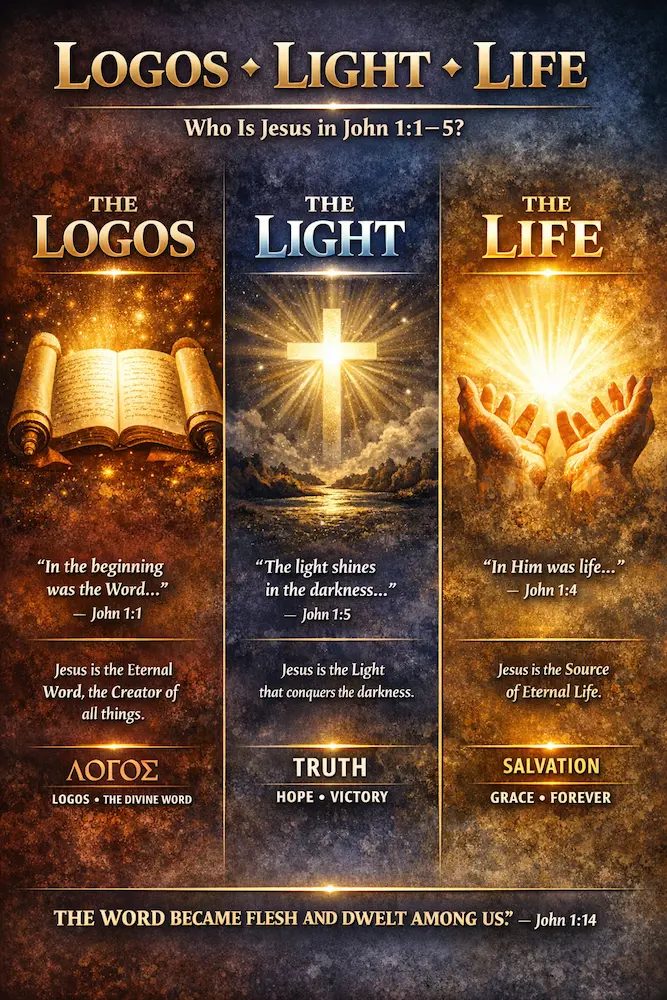
The Eternal Word: Jesus Before Creation (John 1:1)
(Verse 1) The intertestamental period has finally ended. Four hundred years of silence from the God of Israel has come to an end. John makes a bold proclamation about the word becoming flesh.
“In the beginning was the Word, and the Word was with God, and the Word was God.” (John 1:1)
From beginning to end, Scripture points to one person—Jesus Christ.
He is not just part of the story. He is the Word—and the Word is God.
John wastes no time in establishing that Jesus is the Son of God. He was not just a man born in Bethlehem or a New Testament prophet. He is the Son of God, and through him the Word truly became flesh.
We can transpose “Word” for Jesus and the meaning stays the same.
In the beginning was Jesus Christ, and Jesus Christ was with God and Jesus Christ was God.
Notice, “Word” is capitalized. Meaning that it’s not referencing any word but the “Word” who is Jesus Christ. The Bible (God’s Word) is God’s revelation of Jesus Christ to mankind, from the beginning to the end. And Jesus is the revelation of God’s plan for mankind, showing how the word became flesh in history.
If Jesus existed “in the beginning,” what does that reveal about who He truly is?
It means Jesus is not created—He is eternal. Before time began, He already was.
“Word” is translated from the original Greek text logos—a term John’s audience already understood.
To the Greeks, it meant the force that held the universe together.
But John reveals something shocking:
The Logos is not a force.
The Logos is a person.
And the Word became flesh.
Why did John choose the word logos “Word” instead of simply saying “Jesus”?
Because his audience already understood logos as the force behind the universe. John takes that idea and reveals the truth: the Logos is not a force—it is a person. And the Word became flesh.
What Does “The Word Became Flesh” Mean?
“The Word became flesh” means that Jesus Christ, who is fully God, took on human nature and entered the world as fully human also. He did this to reveal God, bring light into darkness, and offer eternal life to all who believe.
Jesus Is God (John 1:2-3)
(Verses 2-3) The life of Christ is the exegesis of the Father. In other words, the life of Christ explains the Father; it’s central to the gospel that the word became flesh.
“He was with God in the beginning.” (John 1:2)
Jesus, in fact, fundamentally determined how the universe functioned. He created all things and brought them into being through himself, demonstrating in creation the reality that the Word became flesh in Jesus.
“Through Him all things were made; without Him nothing was made that has been made.” (John 1:3)
By the use of the word “logos” John knew his readers would understand what he meant. Logos (the Word) (Jesus) is the second person of the Trinity become flesh in humanity to reveal full deity and to make full contact between God and mankind possible. This is how the Word became flesh.
In other words, Jesus was there at the beginning with the Father bringing creation into existence. Therefore, He is God and predates creation being eternal in nature, and this truth is shown as the Word became flesh in the world.
How can Jesus be both with God and be God at the same time?
This is the mystery of the Trinity—distinct in person, yet one in essence.
If Jesus created all things, what does that say about His authority over your life today?
It means nothing is outside His power—including your circumstances.
The Word Became Flesh and Light In a Dark World (John 1:4-5)
(Verses 4-5)
“In him was life, and that life was the light of all mankind. The light shines in the darkness, and the darkness has not overcome it.” (John 1:4-5)
Notice the contrast, Jesus is life. Flesh offers death. All have sinned and fallen short of the glory of God. The wages of sin are death. Therefore, each sinner has to pay the price by death for their sins before a Holy God.
Someone perfect in the flesh (Jesus) came to earth to pay the price (death) for our sins so that we can live eternally with God.
John tells us that in Jesus there is life. It is eternal life. A life attained only through salvation offered by God through the Son. Jesus came to be a light in a dark world. He came to overcome the darkness not to restore this world but give us access to an eternal life in a world for which we were created for.
What kind of life is John talking about here?
Not just physical life—but eternal life that only God can give.
Where do you see darkness in your life right now?
This is exactly where the light of Christ wants to shine.
We are eternal creatures. We were made in the image of God.
But separated from God by sin. Christ came to overcome this world to bridge the chasm that exists between a sinful mankind and God. Furthermore, this demonstrates why the Word had to become flesh. So a man could take on the sins of mankind, therefore be forgiven in the eyes of God and reunited with Him. for those who accept Christ as their Savior.
What if the darkness you’re facing isn’t the end of your story?
John reminds us—darkness never wins when the light of Christ is present.
“I have told you these things, so that in me you may have peace. In this world you will have trouble. But take heart! I have overcome the world.” (John 16:33)
What This Means for You Today
This isn’t just theology—it’s personal.
If Jesus is the eternal Word, then your life is not random.
If He is the light, then your darkness is not final.
The same Word that spoke creation into existence is calling you today—to believe, to follow, and to receive life that never ends.
The Word became flesh so that you could know God—not from a distance, but personally. And when you truly see Jesus for who He is, everything changes.
Go deeper and examine the larger study on the divinity of Jesus in John 1–10.