

Man Was Not Made for the Sabbath: Jesus’ Shocking Response to His Critics
Why did the religious leaders become angry when Jesus healed a man on the Sabbath?
The answer reveals far more than a disagreement about religious rules. In John 5:16-27, Jesus explains that the Sabbath was made for man and uses this controversy to reveal His divine authority as the Son of God. What began as a debate over Sabbath observance became one of the clearest declarations of Christ’s identity in the Gospel of John.
Grace Declared, Resistance Ignited (John 5:16–18)
Bible Study Guide
(Verses 16-18) According to the first verse in this chapter, it was a time of celebration in the city of Jerusalem. They were celebrating one of the Jewish festivals. John doesn’t indicate if it’s the Passover (March-April), Pentecost (fifty-two days later) of the Feast of Tabernacles (September-October).
Notice the contrast in the setting for Jesus’ third recorded miracle of John’s Gospel. While the Jews are celebrating in the city, Jesus chooses to go to a place where there is little to no celebration happening.
This sign of the Son of God healing the invalid would begin a series of confrontations with the Jewish people and the religious leaders. These events would initiate the beginning of the end of Jesus’ ministry that would lead to His death.
Life for Jesus and His disciples was about to take a drastic change.
Why the Sabbath Healing Changed Everything (John 5:19)
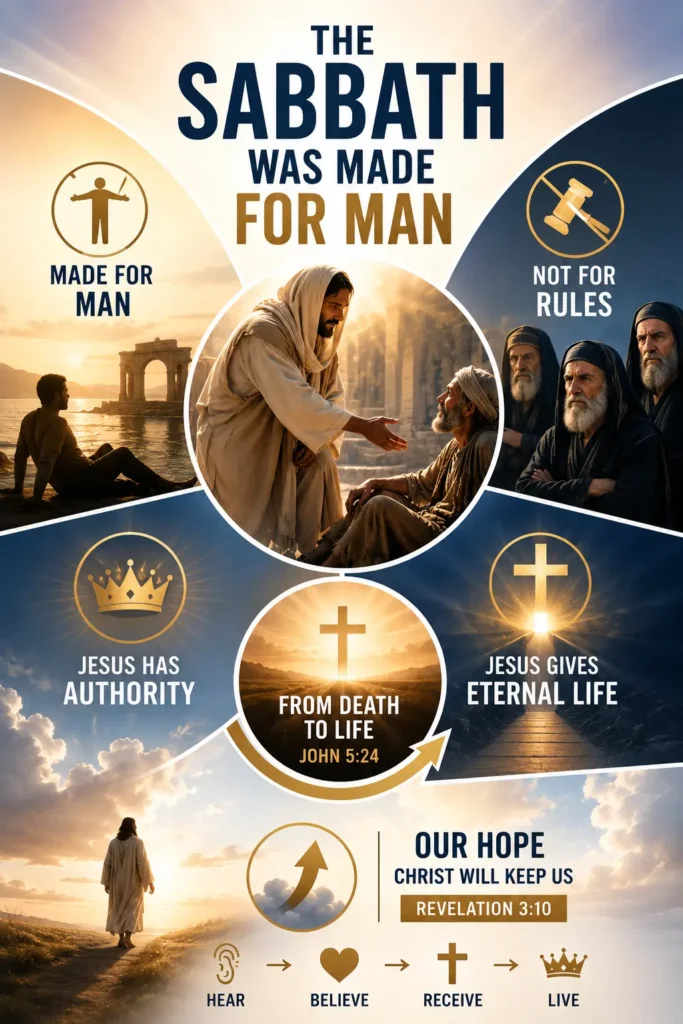
Because Jesus healed this man on the Sabbath, the Jewish people would begin to receive Him differently than they had prior to this. Jesus was about to explain to them that the Sabbath was made for man and not the other way around.
“Then he said to them, “The Sabbath was made for man, not man for the Sabbath.” (Mark 2:27)
But there was something else that would cause the people and religious leaders to begin to persecute Jesus. That something was the fact that He would begin to call God His Father and refer to Himself as the Son of God.
In the eyes of the people of Israel, Jesus was breaking the commandment of no work is to be performed on the Sabbath as given by Moses (Exodus 20:8-11). Also, was making Himself equal to God which they considered blasphemous.
(Verse 19) Depending on the version of your Bible, verse 19 may begin differently. In the New International Version (NIV), Jesus begins with, “Very truly I tell you.”
This is not to indicate in any way that He was not being truthful when He didn’t use this phrase. This is simply to draw attention to what He was about to say. In other words, pay particular attention to what I’m about to say.
It can be related to the way we may sometimes begin telling someone about something really important and we begin by saying, “Honestly.”
Notice how many times times Jesus uses this phrase in the following passages. Pay particular attention to what He says following the phrase and see if you can identify why He’s attempting to draw your attention to what He’s about to say.
The Sabbath Was Made for Man, Not Man for the Sabbath (John 5:20-21)
(Verse 20) Jesus explains to the Jews that the Father is going to show the Son things that will amaze them. He’s referring to the resurrection of Jesus and further works that will come afterwards.
Jesus is trying to point them to the works of God. He wants them to see that the Son who comes in place of the Father for the sake of mankind is much bigger than their observance of the Sabbath. They’re so entrapped by the laws of their religion, that they don’t see the Father through the Son who stands before them.
The Jewish people can’t see themselves releasing their grasp upon the laws of Moses that were given to condemn them and embrace the one who came to perfect them.
(Verse 21) Jesus states that He has been entrusted with all judgment upon the nations and the people. But we’re not to assume that Jesus is there to judge. For there is an appointed to for judgment. He came once to offer the free gift of God’s salvation upon mankind. Upon His second return, He will judge as the righteous Judge.
This passage is a clear testimony to the divinity of Jesus which is expanded more deeply across John 1–10 Bible studies.
Why the Religious Leaders Wanted to Kill Jesus
The religious leaders were not merely upset because Jesus healed a man on the Sabbath. The deeper issue was what His actions and words revealed about His identity.
By healing on the Sabbath, Jesus challenged their understanding of God’s law and exposed how their traditions had obscured its true purpose. But even more alarming to them was His claim that God was His Father. In saying this, Jesus was making Himself equal with God.
The religious leaders understood exactly what Jesus was claiming. To them, His words were not simply controversial—they were blasphemous. As a result, what began as opposition over a Sabbath healing quickly grew into a determined effort to silence Him.
This moment marks a major turning point in John’s Gospel. The conflict was no longer about the Sabbath; it was about whether Jesus truly was the Son of God.
From Death to Life: A Promise of Deliverance From Judgment (John 5:24)
(Verse 24) In John 5:24, Jesus makes an extraordinary promise:
“Whoever hears my word and believes him who sent me has eternal life and will not be judged but has crossed over from death to life.”
Notice that Jesus does not say believers might escape judgment. He says they have crossed over from death to life and will not be judged. The promise is certain because it rests upon the finished work of Christ rather than our own efforts.
This promise echoes later in Revelation 3:10, where Jesus tells the faithful church:
“I will also keep you from the hour of trial that is going to come on the whole world to test the inhabitants of the earth.”
Many believers see in these words a foreshadowing of Christ’s promise to deliver His people from the coming judgment that will be poured out upon the unbelieving world. Just as Jesus promised in John 5:24 that those who believe would not come into judgment, Revelation 3:10 points to a future deliverance for those who belong to Him.
From the beginning of His ministry to the final book of Scripture, Jesus offers the same assurance: those who place their faith in Him have passed from death to life and can look forward to His coming with confidence rather than fear.
Jesus Reveals the Way From Death to Life (John 5:25-27)
(Verses 25-27) Pay close attention to these verses. Jesus uses the “Very truly I tell you” phrase twice. See if you can pick out why He’s drawing our attention to these two points.
It’s because what He’s about to say revolves around the very purpose for which the Father sent him. He’s teaching on salvation. Before Christ, there was no way back to the Father.
Look closely at the word “death” that He uses twice in each of verse 26 and 27. He’s not speaking of physical death of those in the grave. But He’s speaking of those who do not believe in the One (Jesus Christ) sent by the Father (God) to offer His free gift of salvation.
Sin condemns us. Therefore the wrath (eternal death) of God is upon us until the day we come to know who Christ is and accept Him as our Lord and Savior. And when we put our full faith and trust in Him for all things.
This is why John speaks in chapter 3 of God’s wrath that remains on those who don’t believe. It remains because it has been there since birth.
“Whoever believes in the Son has eternal life, but whoever rejects the Son will not see life, for God’s wrath remains on them.” (John 3:36)
Think of it this way. When you were just a child, remember those little lies you would tell your parents to get your way. How about the times you told a lie to get your sibling in trouble. These are not things that your parents taught you. These are things that are part of your sin nature when you were born.
Reflect and Apply:
The religious leaders were so focused on rules that they failed to recognize the Son of God standing before them.
Before we judge them too quickly, we should ask ourselves a difficult question: Have we ever become more focused on religious routines and rituals than our relationship with Christ?
Jesus reminds us that God desires more than outward obedience. He desires hearts that trust Him, worship Him, and recognize His authority. He’s not interested in religion. He wants a relationship between you and Him. Nothing in between.
Consider these questions:
- Am I relying on religious habits instead of a living relationship with Jesus?
- Have I allowed traditions to become more important than God’s purposes?
- Do I truly believe Jesus has authority over every area of my life?
- Am I resting in Christ or trying to earn God’s approval through my own efforts?
The Sabbath was made for man’s benefit, but its greatest purpose was always to point people toward God. Today, that same invitation remains open through Jesus Christ, who alone gives eternal life.
Don’t Stop Here! Continue Your Journey Through John’s Gospel
In this passage about the sabbath was made for man, Jesus has just made one of the boldest declarations of His ministry. In the next passage, He continues explaining why hearing His voice is a matter of eternal life and death.
Continue to the next study and discover what Jesus means when He says, “Today, if you hear His voice.”
Why This Matters So Much Today
The people listening to Jesus faced a choice. They could cling to their traditions, or they could believe the One standing before them.
That same choice confronts us today.
Will we merely admire Jesus as a teacher, or will we trust Him as the Son of God who has authority to give life and judge the world?
The answer to that question determines far more than how we view the Sabbath. It determines where we will spend eternity.
Closing Prayer
Heavenly Father,
Thank You for sending Jesus to be our Savior and the giver of eternal life. Thank You for the promise that all who hear His Word and believe in Him have crossed from death to life and will not come into judgment.
Help us to trust in Christ alone, to rest in His finished work, and to walk faithfully with You each day. Strengthen our faith, deepen our love for You, and keep our eyes fixed on the hope of His return. May our lives reflect Your grace as we share the good news of salvation with those around us.
In Jesus’ name we pray, Amen.