

Why Did Jesus Say, “My Hour Has Not Yet Come”?
At a wedding celebration in Cana, Mary simply informed Jesus that the wine had run out.
His response seems surprising:
“My hour has not yet come.”
What did wine have to do with His hour? Why did Jesus answer a simple request with a statement about timing?
And how does this mysterious phrase point all the way to the cross, the resurrection, and God’s plan of redemption?
Understanding Jesus’ words here unlocks one of the most important themes in John’s Gospel.
Jesus Knew the Cross Was Coming: “My Hour Has Not Yet Come” (John 2:4-12)
Bible Study Guide
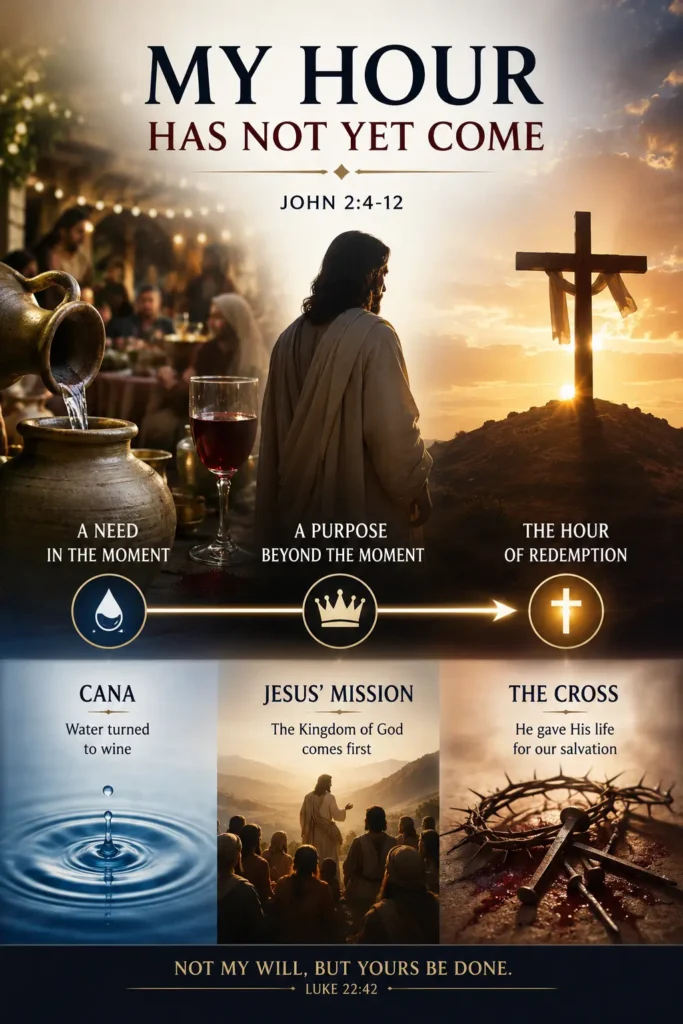
(Verses 4-12) Let’s look at the last part of Jesus’ response to His mother Mary in regard to the wine situation. Notably, one must consider when Jesus used the words ‘hour’, ‘come’, and ‘not yet’—He was saying, in essence, my hour has not yet come according to God’s perfect timing.
Jesus finishes His reply to Mary by saying, “My hour has no yet come.” As we examine this, it’s important that we associate His response to how He’s about to speak to the Pharisee’s, Nicodemus and the Samaritan woman in the coming chapters.
Jesus has begun His ministry. This ministry is about doing the business of His Father. This business is about bringing the message of the Kingdom of God to mankind. In order to do this, Jesus will speak from the spirit and not the flesh. The kingdom of God is of spiritual things while the world is of the flesh. That’s why He would later emphasize ‘my hour has not yet come’ before revealing His mission fully.
This is why Jesus’ answer, at first glance doesn’t appear to match the request or the statement that was made that prompted Jesus’ answer. You’ll see this more clearly when we examine His response to the Pharisee’s in the temple court, Nicodemus and then to the Samaritan woman. In each instance, there is a recurring theme: Jesus waits, suggesting that his specific hour—his appointed time—has not yet come.
When Mary was referring to the fact that they were out of wine, she was making a worldly request for help. However, Jesus’ concern is not of this world but in the kingdom of heaven. He is also focused on spreading that message that He has been tasked to share. All of this points to his insistence that his hour had not yet come.
Even though Jesus’ reply to Mary didn’t quite correspond with her request, He would still go on to perform His first recorded miracle. He changed the water into wine in order to begin to show His glory to mankind. Furthermore, He did this slowly and in a well timed fashion in order to preserve the time set aside for His hour. This demonstrates how Jesus carefully considered the progression leading to the crucial moment—my hour has not yet come.
The miracle itself is rich with symbolism and reveals the first public sign of Christ’s glory. Explore the deeper meaning behind the water, the wine, and Jesus’ first miracle in this study on the Wedding in Cana and Jesus’ First Miracle.
Why Did Jesus Mention His Hour?
Mary’s concern was immediate and practical: the wedding had run out of wine.
Jesus’ concern was eternal.
Throughout John’s Gospel, the phrase “My hour” points toward the culmination of His mission—the moment He would willingly give His life for the sins of the world.
Even while standing at a joyful wedding celebration, Jesus viewed every situation through the lens of the Father’s redemptive plan. The shortage of wine was temporary, but the salvation of mankind was eternal.
This is why Jesus’ response seems unexpected. Mary was thinking about the needs of the moment, while Jesus was thinking about the hour for which He came into the world.
Reflect and Apply:
- Have you ever struggled to understand God’s timing in your life?
- Why do we often focus on immediate needs while God is working toward a greater purpose?
- What does Jesus’ complete focus on the Father’s plan teach us about our priorities?
What Did Jesus Mean by “My Hour Has Not Yet Come?”
Jesus’ hour would come when he had accomplished the spreading of the message of the kingdom of God. He also needed to set up His disciples to take over that message. Then they would continue along with the message of His crucifixion and resurrection so that they might send it out to the world.
There would be a moment when ‘my hour’ had, at last, come—fulfilling what He foreshadowed earlier with the words ‘my hour has not yet come.’
In His hour, He would extend the final covenant with mankind by sharing with His disciples a cup of wine. This cup of wine would symbolize His blood that was about to be shed on the cross for all mankind for the forgiveness of sins. By accepting the covenant, the disciples would take it and drink from it. Then, the covenant was sealed and the disciples became the first members of the church of Christ. The bride of the Lamb.
What importance did the wine have in this moment? Learn how the wine and the wedding will eventually connect to the rapture.
From Wedding Wine to the Cup of the New Covenant
The wine at the wedding in Cana solved an immediate problem, but it also points forward to a much greater reality.
Years later, Jesus would once again take a cup of wine and give it new meaning. At the Last Supper, the cup would symbolize His blood poured out for the forgiveness of sins.
The miracle at Cana was not merely about saving a wedding celebration from embarrassment. It was an early glimpse of the salvation that Christ would provide when His hour finally arrived.
What began with water turned into wine would ultimately lead to the cross, where Jesus would offer Himself for the redemption of the world.
Why the Wedding in Cana Was Not Yet the Cross
At the wedding of Cana. Jesus was thinking of heavenly things, such as His covenant with mankind. It wasn’t time for that, therefore He had no need for wine. Yet again, His statement ‘my hour has not yet come’ makes sense in this context.
Once this covenant is established forever throughout mankind, Christ’s hour will continue with Him being handed over to be persecuted then put to death on the cross. All this was for the purpose of baring the weight of our sins.
All those who accept the blood of His one time sacrifice on the cross, we’ll follow in His resurrection footprints. Then we will all become fruits of His final hour.
Reflect and Apply:
- Are there areas where you are asking God to act immediately while He is accomplishing something greater?
- How does Jesus’ willingness to wait for the Father’s timing strengthen your faith?
- What does Christ’s journey toward His “hour” reveal about His love for you personally?
When Does Jesus’ Hour Finally Arrive?
John’s Gospel repeatedly returns to the theme of Jesus’ hour.
Early in His ministry, Jesus says His hour has not yet come. Later, His enemies cannot seize Him because His hour has not yet arrived.
But eventually the language changes.
As Jesus approaches the cross, He declares that the hour has come.
The “hour” was never about a clock. It was about the appointed moment when the Son of God would fulfill the Father’s plan through His death, burial, and resurrection.
Examine more closely the unfolding revelation of Christ in John 1–10.
Closing Prayer
Lord Jesus,
Thank You for coming into the world to fulfill the Father’s plan of redemption. When Your hour finally came, You willingly gave Your life so we could be forgiven and made new. Teach us to trust Your timing, surrender our will to Yours, and live with eternity in view. May we never lose sight of the cross or the price You paid to save us.
It’s in Your matchless name we pray. Amen.