

Have you ever felt like no matter how hard you try, it’s never enough?
The Bible speaks directly to that feeling—and answers it with one powerful word: grace.
In John 1:14–34, we don’t just learn about grace—we see it arrive in the person of Jesus Christ. And through Him, we experience something even greater: grace upon grace.
Bible Study Guide
What Is Grace in the Bible?
Grace in the Bible is God’s undeserved favor toward sinners. It is the free gift of salvation given through Jesus Christ, not earned by works but received through faith alone. Grace means God gives us what we could never achieve on our own—forgiveness, relationship, and eternal life.
God gives us grace through the perfect sacrifice of His Son on the cross. By the shed blood of Christ we are washed of our sins. Sins He took to the cross to defeat the wages of sin—which is death.
A death we deserved. but Jesus defeated death for us by rising from the dead.
This grace of salvation God gives to you and me. It’s the ultimate grace upon grace.
Why Do We Need Grace?
(Verses 14-15) When John says “the Word became flesh,” he is revealing something astonishing—God stepped into our broken world.
But why would He do that?
Because we needed grace.
Humanity was separated from God by sin—a gap no amount of effort could bridge.
So Jesus came as both fully God and fully man, doing what we could never do: restoring what was broken. Without grace there is no way of getting from this world and back to God.
But grace is the bridge we need that Jesus provided between the Father and us. Jesus did it all.
What if the answer to your brokenness isn’t trying harder—but receiving grace?
What Does Grace Upon Grace Mean?
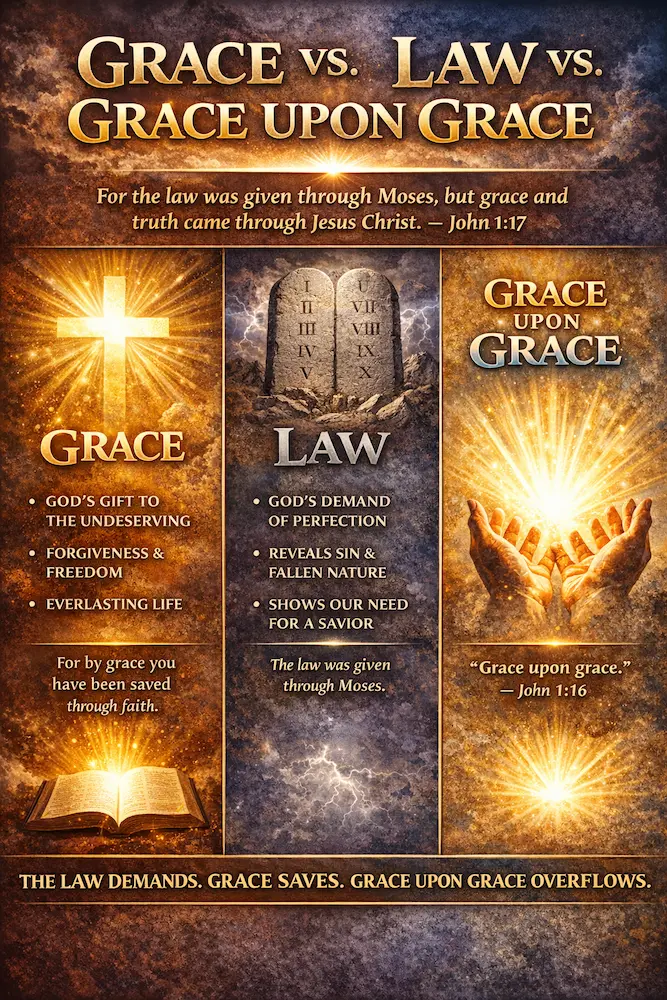
(Verses 16-18) The law, given through Moses, showed us the standard—but not the solution.
It revealed the problem: we cannot save ourselves.
Grace came through Jesus Christ as the answer.
Where the law exposes sin, grace removes it.
Where the law condemns, grace restores.
There is no other grace like it.
“Grace upon grace” means an ongoing, overflowing supply of God’s favor in our lives. It is not a one-time gift—it is grace layered upon grace, moment by moment.
In Jesus, grace doesn’t run out. It multiplies.
Pause for a moment—are you living under law… or under grace?
If the law shows you’re not enough, where do you turn next?
John the Baptist: Pointing to the Source of Grace
(Verse 15-26) John makes it clear to the Pharisees that he is not the Messiah. John can only baptize with water. Jesus, who they knew of through the Tanakh (Old Testament) but didn’t recognize Him in the flesh, would baptize with the Holy Spirit.
(Verses 29-34) John the Baptist understood something critical—he was not the source of grace.
When questioned, he pointed away from himself and toward Jesus.
“Behold, the Lamb of God, who takes away the sin of the world.” (John 1:29)
This is the heart of grace.
Jesus didn’t come to improve sinners—He came to remove sin.
The sacrifices of the past pointed forward. Jesus fulfilled them once and for all.
Are you looking to yourself or religion for change—or to the One who takes away sin?
Are you still trying to earn what God is offering freely?
Today, you can stop striving—and start receiving.
Turn to Christ, trust in Him, and receive the grace that never runs out.
What This Means for You Today
Friends, Jesus loves you so much. He loves you more than any human ever could.
“Greater love has no one than this: to lay down one’s life for one’s friends.” (John 15:13)
Grace is not something you earn—it’s something you receive.
And in Christ, it never runs dry.
“Grace upon grace” means that even when you fail, grace is still there.
Even when you doubt, grace is still there. Or when you fall short and stumble, grace is still there.
Even when you feel unworthy, grace is still there.
The question is not whether grace is available—
It’s whether you will receive it. Receive Him today, while there is still time.
Have you experienced this kind of grace?
Don’t just read about it—respond to it.
Take a moment right now to reflect: where in your life do you need God’s grace today?
Write it down, pray through it, and bring it before Him.
And if this study helped you see grace more clearly, continue growing—explore the the full John 1–10 Bible study series and go deeper into God’s Word.
Closing Prayer
Heavenly Father,
I come before You humbled by the truth that I cannot earn what You have already given. Thank You for Your grace—unearned, undeserved, yet freely poured out through Jesus Christ.
Lord, I confess the times I have tried to rely on my own strength, my own effort, and my own righteousness. Remind me that Your grace is enough. When I fall short, help me to run toward You, not away from You.
Jesus, thank You that You came in the flesh to bridge the gap I could never cross. Thank You for being the Lamb of God who takes away my sin. Because of You, I am not defined by my failures, but by Your mercy.
Teach me what it truly means to live in “grace upon grace”—to receive Your forgiveness daily, to walk in Your truth, and to rest in the assurance that Your love never runs dry.
Fill my heart with gratitude. Transform my life by Your Spirit. And help me to extend that same grace to others.
I receive Your grace today—fully, freely, and without fear.
In Jesus’ name, Amen.