

How the Coming of Jesus Christ Brings Rest to the Faithful and Righteous Judgment to a Christ-Rejecting World
Bible Study Guide
Setting the Context: A Young Church Under Pressure
It had been only a few months since Paul wrote his first letter to the newly planted church in Thessalonica. Yet new and troubling questions had already begun to surface. False reports and deceptive voices were unsettling these young believers—some even claiming apostolic authority.
Paul, like a spiritual father, understood that planting a church also required continual nurturing and protection. Thessalonica sat along a major trade route between Asia Minor and Rome, making it a strategic hub for the spread of the gospel. What was taught here could quickly travel far beyond the city. For that reason, doctrinal clarity was not optional—it was essential.
Grace and Peace in Troubled Times (2 Thessalonians 1:1-4)
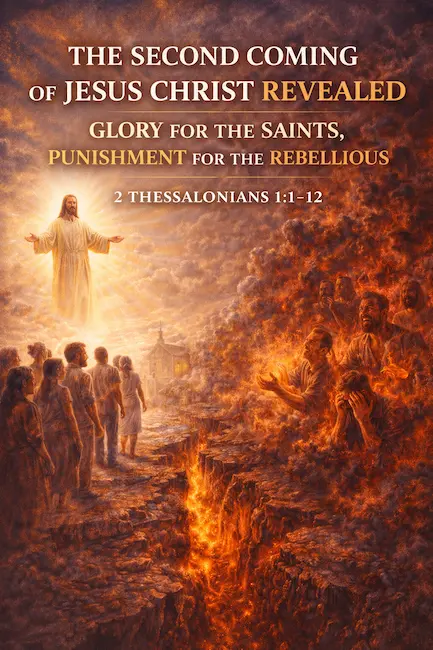
(Verses 1-2) Paul opens with grace and peace, not as formality, but as spiritual reinforcement. Before addressing confusion about the coming of Jesus Christ, he grounds them in what they already possess in Christ: divine grace and sustaining peace. This reminds the church that stability comes not from circumstances, but from their position in God the Father and the Lord Jesus Christ.
(Verses 3-4) Paul immediately gives thanks for their growing faith and increasing love for one another. Their perseverance under persecution is not a sign of God’s absence, but evidence of His work among them.
Here, Paul reframes suffering through an eternal lens. Endurance does not disqualify believers—it confirms them. Their steadfastness points forward to the Second Coming of Jesus Christ, when faithfulness will be publicly vindicated.
God’s Justice and the Promise of Relief (2 Thessalonians 1:5–7)
(Verses 5-6) Paul now shifts from encouragement to divine certainty. God is a righteous Judge. The persecution endured by believers will not go unanswered. Because God is just, unrepented sin will not go unpunished. Relief is promised—but not immediately. It will come “when the Lord Jesus is revealed from heaven”.
This places the believer’s hope squarely in the future revelation of Christ. The coming of Jesus Christ will bring rest to the afflicted and justice to the oppressors. God’s timing is precise, not delayed.
(Verse 7) Paul brings the book of Revelation into focus:
“This will happen when the Lord Jesus is revealed from heaven in blazing fire with his powerful angels.” (2 Thessalonians 1:7)
This paints a picture of Christ becoming the wrath of God upon unrepentant sinners in the Tribulation. It’s Jesus who reveals the wrath of God in Revelation along with powerful angels who orchestrate the punishment that is coming.
Jesus clearly foretold of this in His Olivet Discourse teachings:
“For then there will be great distress, unequaled from the beginning of the world until now—and never to be equaled again.” (Matthew 24:21)
The Sobering Reality of Judgment At the Second Coming of Jesus Christ (2 Thessalonians 1:8–9)
(Verses 8-9) Here Paul speaks with unmistakable prophetic authority. When Christ returns, He will deal decisively with those who reject God and refuse the gospel. This judgment is not symbolic. It is eternal, conscious separation from the presence and glory of the Lord.
Paul does not soften this truth. The Second Coming of Jesus Christ is both glorious and terrifying—depending entirely on one’s relationship with Him.
Paul shifts from our temporal life to the reality of eternity.
“They will be punished with everlasting destruction and shut out from the presence of the Lord and from the glory of his might.” (2 Thessalonians 1:9)
The reality of hell—a concept most find difficult to embrace. In simplest terms, it is an eternal separation from God, the Creator. A perpetual punishment from a loving God is difficult to reconcile.
A human fault has always been to blame others for our troubles. God wishes no punishment on anyone. But, He is a Holy God, who stands apart from sin. An eternal state of punishment is not of God but of human condition brought upon itself.
Sin must be removed to be reunited with God. The only way to remove sin is through Jesus Christ. He bore the punishment for us so that we might be found righteous and holy on the day we are called home to be with the Lord.
Apart from Christ is eternal damnation. Hell is as real as Jesus’ own words on the subject throughout the gospels. In fact, Jesus gives us a parable in (Luke 16:19-31) of the clarity between eternal damnation and everlasting glory that no eye has seen or ear has ever heard.
However, as it is written:
“What no eye has seen,
what no ear has heard,
and what no human mind has conceived—
the things God has prepared for those who love him—” (1 Corinthians 2:9)
Glory for the Saints at the Coming of Jesus Christ (2 Thessalonians 1:10–12)
(Verses 10-12) For believers, the return of Christ is not something to fear, but something to marvel at. Jesus will be glorified in His saints. Those who endured, believed, and remained faithful will share in His glory.
Paul closes with prayer, asking God to make them worthy of their calling and to fulfill every good work prompted by faith. The ultimate goal is clear: that the name of Jesus Christ may be glorified in them, and they in Him.
Closing Reflection on the Second Coming of Jesus Christ
The return of Jesus Christ is not only a promise of glory for the redeemed—it is also a warning of eternal judgment for those who reject Him. Hell is not a metaphor or a myth; it is a real destination spoken of repeatedly by Christ Himself. Jesus spoke more about hell than anyone else in Scripture, not to terrify, but to testify to the seriousness of eternal separation from God.
When Christ returns, justice will no longer be delayed. Every heart will stand exposed before the truth. Eternal punishment is the final consequence of refusing the grace so freely offered through the cross. This reality should not harden us, but awaken us—with urgency, humility, and compassion.
Today is still the day of salvation. The gospel still calls. But the door of mercy will not remain open forever. The Second Coming of Jesus Christ will mark the end of choosing—and the beginning of eternity.
Closing Prayer
Holy and righteous Father,
we come before You with humbled hearts, mindful of the eternal weight of Your truth. Thank You for warning us in love, not leaving us blind to the reality of judgment or the certainty of eternity. We acknowledge that Your justice is perfect and Your mercy is profound.
Keep our hearts awake and our lives aligned with Your will. Let the reality of eternal punishment stir in us a holy reverence—not fear that drives us away, but awe that draws us closer to You. Burden our hearts for the lost, strengthen our witness, and give us boldness to speak the truth in love while there is still time.
Prepare us for Your return. Keep us faithful, watchful, and anchored in Your Word, until the day we stand before You—redeemed, forgiven, and made whole.
In the mighty and saving name of Jesus Christ we pray,
Amen.
Examine the Full Prophetic Thessalonians Bible Study Series